
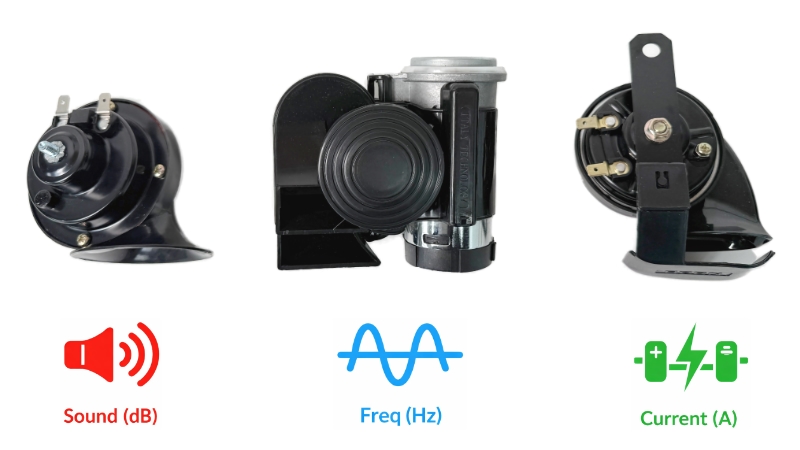
In the past I have purchased expensive Denelli “Sound Bomb” horns as upgrades to the stock horn. The Denelli horns are good, but I wanted to see if I couldn’t find a cheaper alternative.
Whenever you replace your horn, also be aware of potential CAN-bus issues with modern bikes.
More on this at the end of the article.
Purchase & Shipping
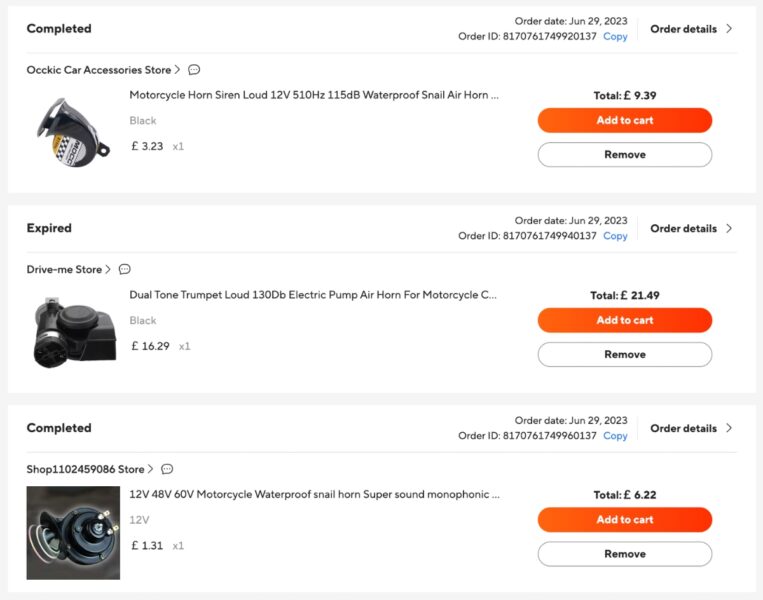
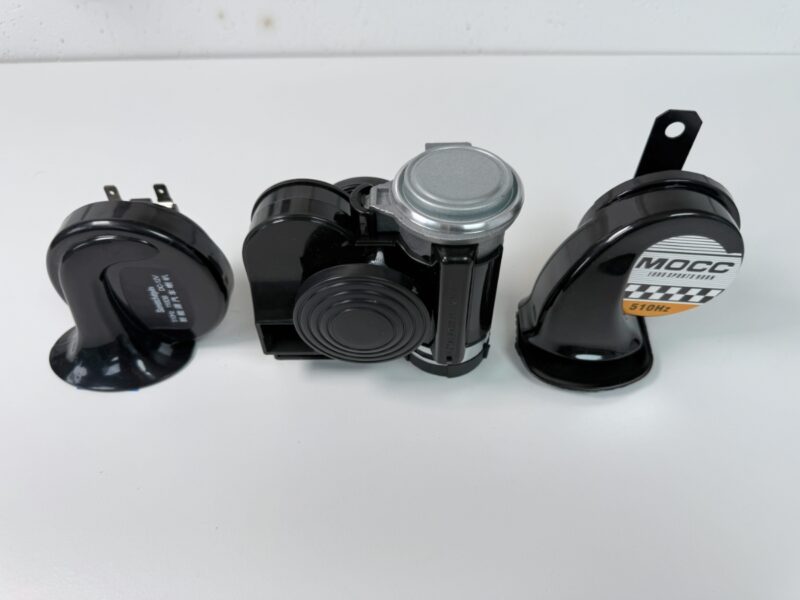
What better place to start looking than AliExpress. I found three different style horns that I knew would fit on my KTM 890 ADV.
Testing Procedure
Loudness (dB)
Measured at 1 metre, straight ahead using a iPhone installed sound meter app.
I realise this is not very scientific or very accurate, but it gives me some standardisation across all horns tested.
Frequency (Hz)
I’m told that the sweet spot for horns is 400-450 Hz. Around 400 Hz cuts through traffic noise well, travels effectively through vehicle cabins, and is perceived as urgent without being painfully sharp. This is why many OEM motorcycle and car horns are “allegedly” tuned close to this range.
Electrical Load (A)
Many horns draw 3–20 amps. I used the ccurrent meter on the power supply to test current draw.
This will give a good indication if you can just replace the horn with your current wiring or will need to activate via a relay.
Horns Tested & Results
Generic – Snail style horn
Cost: £5.79 (US$7.40)
Sound level: 76 dB
Freq: 292 Hz
Current draw: 5.86 A
AliExpress: https://s.click.aliexpress.com/e/_c3biJLXP
MOCC – Snail style horn
Cost: £10.33 (US$13.25)
Sound level: 96 dB
Freq: 1039 Hz
Current draw: 2.10 A
AliExpress: https://s.click.aliexpress.com/e/_c39LWyRj
Dual Tone Trumpet
A Denelli “Sound Bomb” copy, for less than half the cost.
Cost: £17.59 (US$22.51)
Sound level: 100 dB
Freq: 638 Hz
Current draw: 10.30 A
AliExpress: https://s.click.aliexpress.com/e/_c3maYfJJ
CAN-bus Warning!
If you plan to replace your horn on a modern larger capacity bike like a BMW or Ducati, be aware of potential CAN-bus issues. Modern bikes often use a CAN-bus managed electrical system, controlled through a central electronics module, via MOSFET’s (Metal Oxide Semiconductor Field Effect Transistor). The CAN-bus is always looking at current draw, resistance and short and open circuit conditions. This can change how accessory horns behave. Often you will have dash errors if you plug in a new horn.
BMW’s appear to be the most sensitive, but you can also have similar issues with KTM, Triumph etc.
Normally Honda, Suzuki, Yamaha, Harley, Kawasaki are a lot more tolerant.
Even CAN-bus Hondas (Africa Twin, CRF1100L, Goldwing, CB650R, etc.) still use a traditional fused horn circuit, not digitally-driven MOSFET outputs like BMW, KTM etc.
How do get around potential CAN-bus issues?
Use the OEM horn wires ONLY to trigger a relay.
The relay coil draws only 0.15–0.25 A, safe for CAN-bus.
Pull full 12V power directly from the battery (fused).
The other solution is to buy a horn that allows for connection to a dedicated CAN-bus controller.
Denali offers this option, but as you will see, things start to get very expensive!
https://denalielectronics.com/collections/cansmart-accessory-manager
Verdict
The Denelli “Sound Bomb” copy was by far the loudest. But requires a little work to mount it, along with some wiring mods and adding a relay, as it draws over 10 A.
The MOCC snail-style horn is the one I will use. It was reasonably loud, gave a much better tone/freq than the stock KTM horn, and appeared much louder in this very unscientific test. Also, the current draw around the same as the stock horn, so it’s an easy replacement.
The generic snail-style horn was junk, it was the cheapest of the three, would require some wiring mods and a relay, also sounded flat and horrible. I guess you get what you pay for 🙂
None of the horns worked in the ideal frequency range, although that could be more of a product of my testing and using an iPad as a sound level and frequency meter.
At the end of the day, it was an interesting exercise and I learnt a little about CAN-bus.